
Change of Ownership (CHOW): Buying and Selling in Healthcare

Corporate and Compliance Attorneys that handle (CHOW) Change of Ownership in Healthcare.

Table of Contents

Juan Santos LL.M. Talks About Change of Ownership (CHOW)

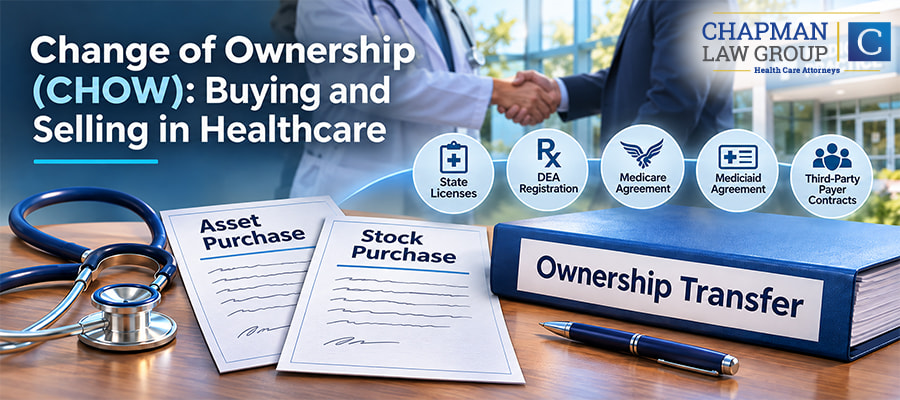
A change of ownership (CHOW) in the health care industry involves a regulated legal and administrative transition that happens when a medical practice, clinic, or health facility is sold, leased, or transferred to a new owner or control structure. There are different Federal and State CHOW legal and administrative processes that may vary depending on if you are transferring for example:

    1. A State health care license to operate;
    2. DEA Registration;
    3. Medicare Provider Agreements;
    4. Medicaid Provider Agreements;
    5. Any third party payer contracts, etc.

Moreover, the legal and administrative process may vary depending on the type of corporate transaction that you execute. An Asset Transaction CHOW process is different from a Stock Transaction Chow process.

The consequences of not understanding the Chow legal and administrative processes are extremely serious. Get it right and the transition process should be a lot smoother while getting it wrong has consequences that can outlast the transaction itself, potentially including administrative and civil liability. In this article, we will cover the ownership process, provider agreement assignment, key timelines, practical steps to protect reimbursement, and everything in between to make sure healthcare buyers, sellers, and providers understand what needs to be done before, during, and after a change of ownership occurs.

Got A Question?
Contact me now to schedule a consultation.
Got A Question?
Contact me now to schedule a consultation.

What Is a Change of Ownership (CHOW) in Healthcare?

A CHOW in healthcare is not the same as a change of ownership in any other industry. When a restaurant sells, the new owner walks in and opens the doors. When a healthcare provider sells, every license, registration, third party payer enrollment, and private  and governmental payer contract tied to that business must be individually addressed.

The Legal Definition Under 42 CFR § 489.18

Under federal regulation 42 CFR § 489.18, a change of ownership (CHOW) is a reportable ownership event that determines whether a Medicare Provider Agreement and its associated billing privileges transfer from seller to buyer. CMS defines CHOW differently depending on the type of legal entity involved:

    • Partnership: a CHOW occurs when a partner is added, removed, or substituted — a fact that catches many physician group buy-ins and retirements off guard.
    • Sole proprietorship: a CHOW occurs when title and the practice’s property transfer to a new party.
    • Corporation: a CHOW is triggered by a merger or consolidation. A stock transfer alone does not constitute a CHOW unless cumulative transfers exceed 50%.

That determination matters far beyond paperwork. CHOW status controls whether the buyer steps into the seller’s existing Medicare provider agreement — inheriting its billing number, compliance history, and liabilities — or must start the enrollment process from scratch as a new applicant.

Transactions That Do Not Constitute a Formal CHOW

Understanding what falls outside the CHOW definition is equally important for transaction planning:

    • A simple stock transfer within the same provider corporation where cumulative changes remain below 50%
    • Internal corporate reorganizations that do not change the operating entity’s legal identity or controlling ownership
    • Management company changes alone, without a corresponding ownership transfer
    • Name changes that leave the underlying legal entity and ownership structure intact

Although the CHOW process may not apply to the transactions set forth above, there are still other regulations that may be involved such as conducting a Stock Transfer Notification with a certain State and/or Federal Agency. These carve outs are not absolute. Each situation requires analysis against CMS definitions, state licensing rules, and individual payer contracts, all of which may apply different thresholds to the same transaction.

What is the Difference Between CHOW and Change of Control?

A Change of Control refers to a significant shift in officers, directors, or management without necessarily changing who legally owns the entity. Many healthcare licenses and third party payer contracts include change of control provisions that require separate notification or approval, independent of whether a CHOW is triggered under Medicare regulations.

The thresholds vary by license, contract, and state. A transaction that does not meet CMS’s definition of a CHOW can still trigger change of control provisions in a state license or managed care agreement, running its own parallel track of notifications, approvals, and timelines alongside the deal. Treating the two as interchangeable is one of the more common and costly planning mistakes in healthcare transactions.

What Clients Are Saying

Victor D'Amato
Victor D'Amato
Google Reviews
Juan Santos was very professional in his representation of my interests. He worked with me to fix a major problem that was created by a prior attorney that I had been using. I would highly recommend his services if you are acquiring a home health agency.
Doug Hobbs
Doug Hobbs
Google Reviews
I had a complex case. Some of the billing done by my billing staff did not match billing done by a 3rd party auditor. Billing is an unusual skill. As many of you know, excellent billers often disagree about the best way to bill for the exact same services. Ron Chapman Sr handled my case. He was able to resolve my case. and his rates were reasonable. My local attorneys did not have the kind of experience necessary to deal with the large bureaucracy of the government. He took what began as a lot of scary threats by the government, and reached a simple solution.
Gregory Brown
Gregory Brown
Google Reviews
I’m so please with the Chapman Law group services Attorney Juan Santos was professional and clearly explained the process from the beginning and through out the waiting period. I will be recommending your services going forward. Respectfully Dr. Brown
Karen Mason
Karen MasonGoogle Reviews
Our company has been working with Ron Chapman's group for over 12 years. Ron and his team respond rapidly with their guidance, advisement and expertise. Their knowledge and experience are invaluable.
Alisha Curry
Alisha Curry
Google Reviews
Mr. Chapman Sr graciously took a case involving my brother and gave a us great hope in a very desperate time. Mr. Chapman takes time making his clients feel comfortable explaining the process. He showed great compassion for the situation. I cant thank Mr. Champman and the Chapman Law Group enough for all there help.

Why Healthcare Transactions Are Different From Every Other Business Sale

Buying or selling a healthcare business involves the same core elements as any other acquisition, including conducting due diligence, negotiating a purchase price, analyzing the correct deal structure, and negotiating a certain Purchase Agreement and ancillary Closing Documents.

What makes the healthcare industry different is everything that comes after the execution of the Closing Documents. A healthcare provider doesn’t just own a business, it holds a collection of government-issued enrollments, state-issued licenses, federal registrations, and contractual relationships with third party governmental and private payers that will determine whether you, as the new owner, can continue operating the business uninterruptedly and continue to legally submit claims for reimbursements.

The Licenses, Registration, and Contracts at Stake

When a healthcare business changes hands, the following must each be individually evaluated and addressed:

    • Medicare enrollment and billing privileges — governed by CMS, processed through the applicable Medicare Administrative Contractor
    • Medicaid enrollment — state-administered, with requirements that vary significantly by state
    • State healthcare licenses — each state has its own notification, application, and approval requirements
    • DEA registration — non-assignable under federal law; a new registration may be required depending on deal structure
    • NPI (National Provider Identifier) and PTAN (Provider Transaction Access Number) — must reflect the new owner post-closing
    • Third-party payor and managed care contracts — often contain assignment clauses requiring payer consent; re-credentialing timelines can run 90 to 180 days
    • CLIA certificates — laboratory certification tied to the facility and director; may require re-application
    • Accreditation — Joint Commission, CHAP, ACHC, and others must be notified of a change of ownership to maintain accreditation status

A gap in any one of these can mean services are rendered but cannot be billed. For providers where Medicare and Medicaid represent the majority of revenue, even a short interruption has significant financial consequences.

Why a General Business Attorney Is Not Enough

A transaction attorney who does not specialize in healthcare can competently handle the deal structure, draft the purchase agreement, and negotiate representations and warranties. What they cannot do, is navigate the regulatory layer that sits on top of every healthcare transaction. This is because it requires a healthcare attorney with vast knowledge of CMS enrollment regulations, state licensing administrative process, DEA requirements, and payer credentialing processes that a general M&A practice does not cover.

The consequences of that gap are not theoretical. A missing DEA notification, a late CMS-855 filing, or an inherited Medicare overpayment demand that wasn’t discovered in due diligence can each cost more than the price you paid for the entire business.

Chapman Law Group’s healthcare transaction attorneys have spent their careers working on both sides of these issues, structuring the deals and defending the legal and compliance consequences when the regulatory layers were not properly handled.

Structuring the Deal: Asset Purchase vs. Stock Purchase

Every healthcare transaction begins with the same fundamental question, are you buying the assets of the business, or are you buying the stock or membership interest (equity) of the legal entity?

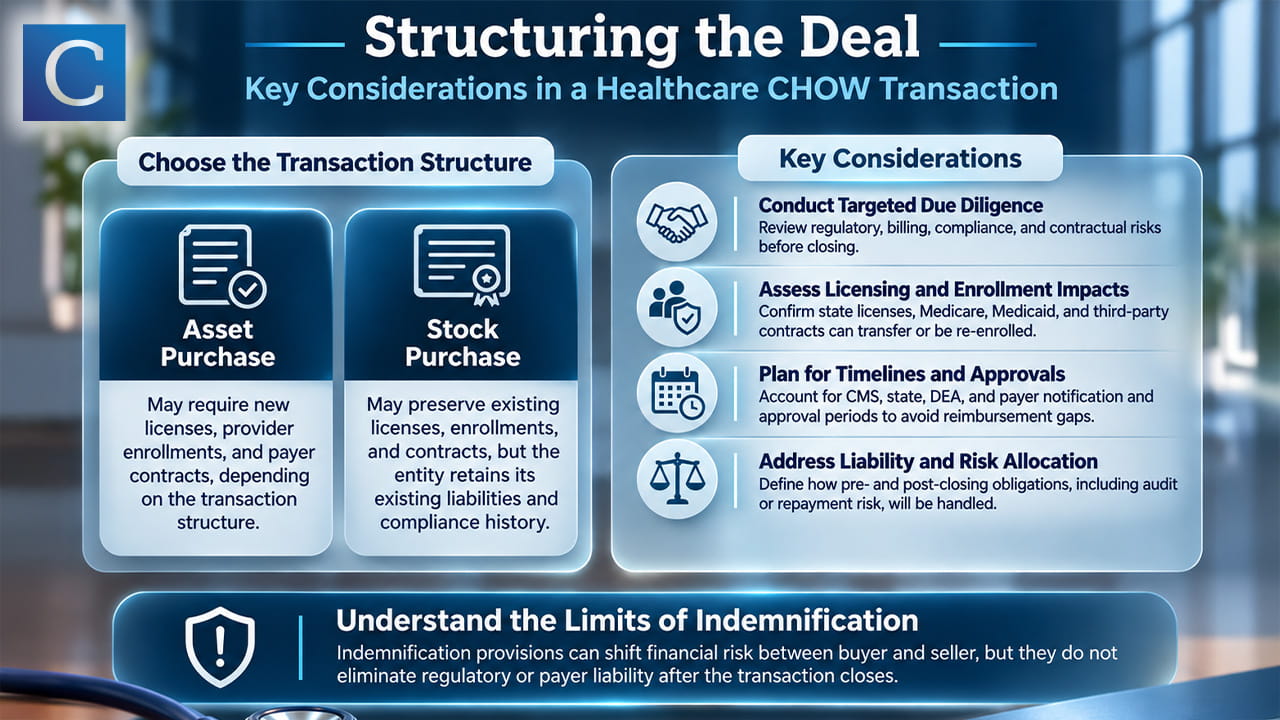
In an asset purchase, the buyer acquires selected business assets rather than the legal entity itself, potentially requiring new licenses, provider enrollments, and payer contracts. Conversely, a stock purchase transfers ownership of the existing legal entity, which may preserve certain licenses and contractual relationships but also carries the risk of assuming existing liabilities and compliance obligations.

That fundamental decision determines far more than tax treatment and liability exposure. In healthcare, it determines which licenses carry over, whether Medicare enrollment continues uninterrupted, what happens to DEA registrations, and whether a change of ownership filing is required at all. Getting the structure wrong or choosing it without understanding the regulatory consequences creates problems that no amount of post-closing paperwork can fully fix.

How Deal Structure Determines Change of Ownership (CHOW) Requirements

Because each transaction type carries different implications for Medicare, Medicaid, state licensure, DEA, and payer contracts, the structure must be analyzed across every regulatory layer before the letter of intent is signed, not after. Choosing a structure for tax reasons alone, without accounting for the regulatory consequences, is one of the most common and costly mistakes in healthcare transactions.

Why Your Purchase Agreement Cannot Completely Protect You From CMS

The instinct to address Medicare liability through the purchase agreement is understandable but insufficient. An indemnification clause obligates the seller to cover certain post-closing liabilities, but only if the seller has the financial capacity to do so. A seller who is judgment-proof, insolvent, or simply unwilling to honor the indemnification leaves the buyer with a contractual right that cannot be enforced.

State Licenses, Medicaid, and Payer Contracts in the CHOW Process

Medicare is the most prominent regulatory layer in a healthcare change of ownership, but it is not the only one. A completed Medicare CHOW filing does not update state licenses, Medicaid enrollment, or commercial payer contracts. Each operates on its own timeline, under its own rules, and with its own consequences for noncompliance.

State Licensure Does Not Transfer Automatically

Every state has its own requirements governing what happens to a healthcare facility license when ownership changes. Some states require formal application and approval before the transaction closes. Others require notification within a specified window after closing. The consequences of missing either vary, but in most cases, they include the risk of operating without a valid license, which can itself trigger State regulatory action independent of the Medicare CHOW.

Third-Party Payor Contracts and Managed Care

Commercial payer contracts do not follow a change of ownership automatically. Most contain assignment clauses that require the payer’s written consent before the contract can be transferred to a new owner. Without that consent, the buyer may find itself operating without an active in-network agreement, meaning claims are processed at out-of-network rates or denied entirely.

Re-credentialing with commercial payers following a change of ownership can take 90 to 180 days depending on the payer. Medicare Advantage plans require their own re-credentialing process separate from the Medicare CHOW. Panels that are close to new providers may not re-credential the new owner at all, which can be a critical revenue risk for practices dependent on a specific payer relationship.

This is an area where the stock purchase structure can provide a meaningful advantage. When the legal entity does not change, existing payer contracts may remain in place without requiring payer consent, though this depends on the specific language of each contract and should be confirmed during due diligence.

NPI, PTAN, CLIA, and Accreditation

Several additional identifiers and certifications must be updated or re-evaluated following a change of ownership:

    • NPI (National Provider Identifier): Individual NPIs stay with the practitioner; group NPIs tied to the legal entity must be updated to reflect the new owner in the National Plan and Provider Enumeration System
    • PTAN (Provider Transaction Access Number): linked directly to Medicare enrollment and must reflect the new owner post-closing
    • CLIA certificate: laboratory certification tied to the facility’s director and location — may require re-application following a change of ownership depending on the transaction structure
    • Accrediting organizations: including the Joint Commission, Community Health Accreditation Partner (CHAP), and Accreditation Commission for Health Care (ACHC) must be formally notified of a change of ownership to maintain the provider’s accreditation status; a lapse in accreditation can affect both Medicare participation and payer contracting

FREE eBook!

Click the link below to download our compliance eBook now!

FREE eBook!

Click the link below to download our compliance eBook now!

Special Rules for Home Health Agencies, Hospice Providers, and Skilled Nursing Facilities

Certain Medicare-certified provider types carry additional change of ownership requirements that can fundamentally change the economics of a transaction. Buyers and sellers of home health agencies, hospice providers, and skilled nursing facilities must understand these rules before any deal is structured.

The 36-Month Rule for Home Health and Hospice

Under CMS guidance, if a home health agency or hospice undergoes a change in majority ownership within 36 months of its initial Medicare enrollment, or within 36 months of its most recent change in majority ownership, the existing Medicare enrollment does not transfer to the new owner. The buyer must enroll in Medicare as a new provider and obtain a new state survey or accreditation before participation is established.

The practical consequences are significant. The buyer cannot bill Medicare during the enrollment and survey process. Survey timelines vary by state and accrediting organization. The cost of the survey, any required corrective actions, and the revenue gap during the enrollment period must all be factored into the purchase price and deal structure. Buyers evaluating a home health or hospice acquisition should request the target’s complete Medicare enrollment history as one of the first steps in due diligence before the letter of intent is signed.

The 2026 Updates to CMS Enrollment Moratorium

Effective May 13, 2026, CMS imposed a nationwide enrollment moratorium on new home health agencies and hospices as an anti-fraud measure. During the moratorium, new enrollment applications for these provider types will be denied. The direct impact on change of ownership transactions are that any CHOW involving a home health agency or hospice that requires new provider enrollment under the 36-month rule will be denied during the moratorium period. If the transaction cannot be structured to qualify for a 36-month rule exception, the deal cannot be completed and Medicare enrollment cannot be obtained until the moratorium is lifted.

CMS has authority to extend the moratorium in additional six-month increments. As of the date of this publication, the moratorium remains active. Buyers and sellers of home health agencies and hospice providers must assess 36-month rule applicability and moratorium exposure before signing any letter of intent.

Skilled Nursing Facilities and Other Institutional Providers

Skilled nursing facilities and other Medicare-certified institutional providers face their own CHOW-related requirements. A change of ownership may trigger a state survey, life-safety inspection, or accreditation review as a condition of continued Medicare participation. These add both cost and time to the transaction.

Buyers accepting the provider agreement in a skilled nursing facility acquisition inherit the seller’s full compliance history, including civil monetary penalties, quality metric findings, and any open corrective action plans. These factors affect both the regulatory risk profile of the acquisition and the value of the provider agreement being assumed.

The Change of Ownership Process: Planning and Due Diligence Before a Healthcare Change of Ownership

Understanding the regulatory requirements of a healthcare change of ownership is the foundation. Executing them correctly in the right sequence, on the right timeline, is what determines whether the transaction closes cleanly or not at all.

When Planning for CHOW Should Actually Start

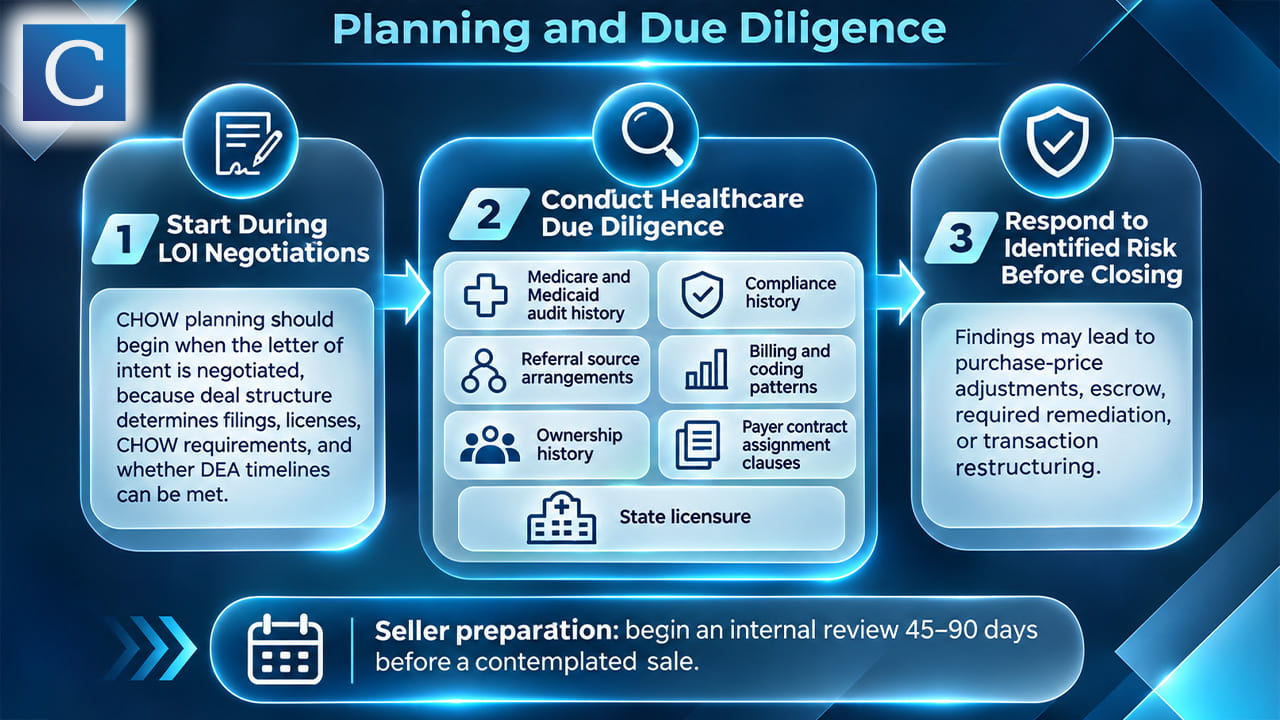
The most common mistake in healthcare transactions is treating the CHOW process as a closing task. By the time the purchase agreement is signed, and a closing date is set, several decisions that drive the entire regulatory process have already been made or left unaddressed in ways that cannot easily be corrected. CHOW planning should begin when you are negotiating the letter of intent.

The LOI is when deal structure is set, and deal structure determines whether a CHOW is required, which filings apply, what licenses need to be reapplied for, and whether the DEA timeline can realistically be met before closing. Sellers should begin an internal audit of Medicare enrollment records, Medicaid enrollment, state licenses, and payer agreements at least between 45 – 90 days before a contemplated sale.

The Due Diligence Process for Healthcare Buyers

Healthcare due diligence goes beyond reviewing financial statements and tax returns. A buyer’s financial picture of the practice is only as accurate as the compliance picture beneath it. Key areas requiring investigation include but are not limited to:

    • Medicare and Medicaid audit history: any open RAC, MAC, or OIG matters
    • Compliance history: civil monetary penalties, exclusions, corrective action plans
    • Referral source arrangements: Anti-Kickback Statute exposure that does not appear on a balance sheet
    • Billing and coding patterns: upcoding or insufficient clinical documentation creates post-close repayment exposure
    • Ownership history: particularly for home health and hospice providers subject to the 36-month rule
    • Payer contract assignment clauses: including re-credentialing requirements
    • State licensure: status and any pending regulatory matters

Where due diligence uncovers material compliance risk, the appropriate response depends on the nature and scope of the issue. Options include adjusting the purchase price, placing funds in escrow pending resolution, requiring remediation as a closing condition, or restructuring the transaction to avoid inheriting the liability entirely.

Got A Question?

Contact us now to schedule a consultation.

Got A Question?

Contact us now to schedule a consultation.

How Chapman Law Group Handles Healthcare Transactions and CHOW

Chapman Law Group combines healthcare corporate transaction counsel with regulatory compliance and defense experience to address these issues as part of a coordinated legal strategy. Unlike firms whose work ends with the execution of closing documents, Chapman Law Group’s attorneys can assist with the regulatory requirements that extend far beyond the sale. This includes evaluating Medicare and Medicaid enrollment, state licensing, DEA registration, third-party payer agreements, and potential compliance liabilities. Where due diligence reveals problems, the firm’s attorneys can help negotiate appropriate contractual protections, closing conditions, and corrective measures before those issues jeopardize the transaction or the provider’s operations.

Our Attorneys with Notable Expertise in Healthcare Related Corporate Transactions.

Chapman Law Group’s healthcare corporate transaction attorneys bring direct experience on both sides of that process:

    • Juan Santos LL.M. is a Shareholder, Senior Attorney, and Practice Chair of the Healthcare Corporate and Compliance division at Chapman Law Group.Juan C. Santos, LL.M. – Shareholder and Chairperson of Chapman Law Group’s Healthcare Compliance and Corporate Transactions practice group, has spent his career advising physicians, medical groups, pharmacies, DME companies, and facility clients on regulatory, compliance, and transactional matters, including DEA compliance, Medicare enrollment, Anti-Kickback Statute and Stark Law analysis, and the defense of Medicare audits and overpayment demands. He has also represented healthcare professionals facing investigations by the Department of Justice, FBI, OIG, and DEA, which means he understands not just how these transactions should be structured, but what happens when they aren’t.
    • Jonathan Lanesky is a Shareholder and Senior Attorney at Chapman Law Gorup. He practices in Medical Licensing and Regulatory Affairs, and Healthcare Compliance.Jonathan Lanesky – Shareholder in Chapman’s Troy, Michigan office, brings more than 25 years of experience advising healthcare organizations through mergers, acquisitions, affiliations, joint ventures, and the full range of corporate and compliance challenges that accompany them. His practice spans CMS regulatory requirements, Stark Law, Anti-Kickback Statute, False Claims Act, third-party payer audits, and professional licensing matters across a wide range of provider types.

Call Chapman Law Group for Help with CHOW Related Matters.

Chapman Law Group has been defending healthcare providers for more than 35 years, with a practice devoted exclusively to healthcare law. Whether you are buying, selling, or restructuring a healthcare business, and regardless of where in the country that transaction takes place, Chapman’s attorneys have the experience to guide it from structure through closing. Click below to contact us today. 

CONTACT US HERE

Frequently Asked Questions About Change of Ownership (CHOW)

When does a healthcare transaction actually count as a CHOW for CMS purposes?

 Not every internal restructuring triggers CHOW. Changes in majority ownership, controlling interest, or the legal operator typically do. An asset purchase almost always triggers CHOW, while a simple stock transfer within the same provider corporation may not, unless cumulative shifts exceed 50%. Providers should compare their specific situation to CMS definitions and consult their MAC for guidance on their particular situation.

How does CHOW impact individual physicians in a group practice?

 Group-level CHOW often requires updating the group’s CMS-855B and PECOS records, but individual provider enrollments and reassignment of benefits may remain intact if NPI, tax IDs, and group affiliations are properly maintained.

What happens if we miss the CMS CHOW reporting window?

 CMS can reject or delay the CHOW, potentially suspending billing privileges for services rendered after the ownership change. Late filers may need to appeal or, in some cases, submit as new entrants, which triggers a full new enrollment review.

Is CHOW treatment the same for Medicare and Medicaid?

 No. Medicare CHOW is governed by CMS and processed via MACs under federal regulations. Medicaid enrollment is state-specific and may classify the same transaction differently, requiring separate filings and approvals. Commercial payers add yet another layer with their own consent and re-credentialing requirements.

Can we keep billing Medicare during the CHOW process?

 Every specific situation is different so a blanket answer cannot be given, however, generally if forms are timely and accurate and the provider agreement is assigned, billing may continue. However, CMS does not guarantee uninterrupted payment. Delays can occur if information is incomplete or if the MAC requests additional documentation. The CHOW process impacts Medicare participation and financial stability post-sale, so build a cash reserve into your transition plan. Consult a CHOW attorney like those at Chapman Law Group to asses your specific circumstances.

Need an Attorney? Contact us now!
or Call us at: 1 (877) 234-5911

"*" indicates required fields

This field is for validation purposes and should be left unchanged.
SMS Consent
Got A Question?
Contact me now to schedule a consultation.

Other Practice Areas​

Healthcare Corporate Transactions & Business Matters

Related Case Results

Related Blog Posts

FREE Health Care Newsletter

Stay up to date on the latest news in health care law!

FREE eBook!

Click the link below to download our compliance eBook now!

Got A Question?

Contact me now to schedule a consultation.
Chapman Law Group Favicon

This website uses cookies to ensure you get the best experience on our website.

Send this to a friend