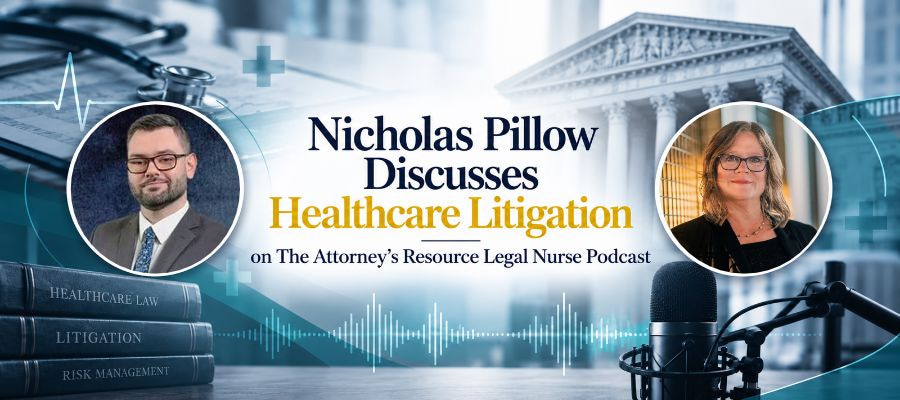
Nicholas Pillow Discusses Healthcare Litigation on The Attorney’s Resource Legal Nurse Podcast
Table of Contents
Healthcare Litigation from the Defense Perspective
Chapman Law Group Civil Litigation Attorney Nicholas B. Pillow appeared on Episode 12 of The Attorney’s Resource Legal Nurse Podcast, hosted by Jaimee Gerrie, a registered nurse, legal nurse consultant, and founder of UPvision Consulting. The podcast features attorneys discussing how medical knowledge informs litigation strategy and the role of legal nurse consultants in case preparation. During the episode, Pillow described how he works with nursing experts to evaluate medical allegations and develop arguments for dismissal before trial. He discussed his approach to reviewing case materials, preparing depositions with input from medical experts, and identifying defense strategies based on the evidence. He examined the procedures that can delay outside medical treatment in correctional facilities and explained why allegations in a civil demand letter may warrant an assessment of a healthcare provider’s licensing and criminal liability risks before a lawsuit is filed.
How Nursing Experts Evaluate Medical Malpractice Claims and Support Early Dismissal
Pillow described bringing nursing experts into medical malpractice cases before discovery begins, sometimes when he has only the complaint to review. Their clinical knowledge helps him examine the treatment decisions underlying the allegations and determine whether there are grounds to seek dismissal. He uses that information to explain the medical circumstances to a judge, with the goal of resolving the case before trial.
Pillow recalled a case involving atrial fibrillation (AFib) in which a nurse used her hands to demonstrate what happens to the heart during the condition. “I was able to craft a really good brief because I was able to explain what was going on with the patient in a much better, more concise way.” He credited that explanation with helping him exit the case earlier, illustrating how medical expertise can contribute to a litigation strategy.
Pillow also addressed the importance of maintaining communication with nursing experts throughout litigation. He described how experts may conduct an initial review and then wait several months while discovery proceeds or depositions are scheduled. In one instance, after a plaintiff declined to depose a nurse practitioner, Pillow asked the expert to keep the case file open while the defense pursued a dispositive motion. Keeping experts informed of these developments helps establish when additional reviews or testimony may be necessary without requiring their continuous involvement.
Administrative Barriers and Medical Expert Challenges in Correctional Healthcare Litigation
Correctional healthcare providers do not control every step involved in obtaining outside medical treatment for incarcerated patients. Pillow described how requests for specialist consultations must pass through utilization management before correctional administrators coordinate transportation and custody. Even after a consultation receives approval, these procedures can delay treatment without the provider having authority over when the appointment takes place. In lawsuits alleging delayed care, distinguishing a provider’s medical decisions from administrative delays can help establish which actions were within their control. Pillow emphasized that medical experts unfamiliar with correctional healthcare may overlook these institutional procedures when evaluating allegations against providers.
Finding medical experts with correctional healthcare experience presents another obstacle. Gerrie described an instance in which a corrections nurse declined to serve as an expert because of a potential conflict of interest. Pillow explained that he and his paralegal had spent several months expanding their network of experts because the number of available professionals with correctional healthcare experience was limited. Nurses, physicians, nurse practitioners, and physician assistants may all be difficult to retain when professional conflicts further restrict the available pool. These limitations can affect an attorney’s ability to obtain expert reviews and testimony when defending correctional healthcare providers.
Criminal and Licensing Exposure in Healthcare Civil Litigation
Pillow recalled representing a client who received a demand letter threatening civil litigation before a lawsuit had been filed. Although the client initially sought assistance responding to the letter, its allegations of healthcare fraud and improper payments raised concerns beyond the potential financial consequences of a civil lawsuit. Recognizing that these allegations could also involve criminal liability and medical licensing consequences, Pillow advised the client, “I want to connect you with my white collar team, and I want to connect you with my licensing team.” Because Chapman Law Group’s civil litigation, criminal defense, and licensing attorneys operate within the same firm, Pillow could consult his colleagues directly and coordinate the client’s representation without requiring them to seek counsel from separate law firms, which would waste precious time and resources.
Pillow also addressed how settlements and judgments can affect a healthcare provider’s professional record through the National Practitioner Data Bank (NPDB). Under federal reporting requirements, medical malpractice payments made by an entity on behalf of an individually identified practitioner may be reportable when they result from a written claim or judgment. Payments made solely on behalf of a healthcare organization generally do not trigger the same individual reporting requirement. Pillow discussed considering these distinctions when negotiating settlements and the ability of practitioners to submit statements explaining their position when a report is filed. These considerations can influence how attorneys approach a civil resolution, particularly when the provider faces potential consequences beyond the settlement payment itself.
What Clients Are Saying
Tom Smoot
☆☆☆☆☆
Troy, Michigan
Aaron Kemp was absolutely amazing. He helped me through one of the most difficult times in my life and was completely reasonable with his pricing. I never once felt like he was only in it for the money, I felt he genuinely cared about seeing me come through everything with my license and reputation intact.
Kimberly Hutchinson
☆☆☆☆☆
Orlando, Florida
I have been an R.N. for 28+ years and worked at the same hospital for a total of 31 years, 28 as an R.N. I called THE CHAPMAN LAW GROUP. First off I never had to make another call. Sara Bazzigaluppi, Attorney was assigned to my case with her amazing assistant Griceli Vargas-Gonzalez. Knowledgeable in the art of medicine and so kind and reassuring that by the end of our first phone conversation we were on a first name basis, Sara (attorney) and Griceli ( legal assistant ). This was worth every penny that was spent to have had such amazing, down to earth, legal team fighting for my career and my reputation.
Marcello Carrio
☆☆☆☆☆
Detroit, Michigan
Mr. Chapman was referred to me by another attorney who told me he would be the best attorney for my case. I’m so grateful I had the opportunity to use him. Mr. Chapman is sharp, hard working and very dedicated to me as his client. He took over the court, made things very clear and won my case! If you’re looking for an attorney that’s professional and cares for his client, Mr. Chapman is on top of his game. A very honorable person. I would highly recommend him if you’re looking for an amazing criminal attorney that will fight for you.
Doug Hobbs
☆☆☆☆☆
Oakland, Michigan
I had a complex case. Some of the billing done by my billing staff did not match billing done by a 3rd party auditor. Billing is an unusual skill. As many of you know, excellent billers often disagree about the best way to bill for the exact same services. Ron Chapman Sr handled my case. He was able to resolve my case. and his rates were reasonable. My local attorneys did not have the kind of experience necessary to deal with the large bureaucracy of the government. He took what began as a lot of scary threats by the government, and reached a simple solution.
Nicholas Pillow's Unique Approach to Reviewing Evidence and Preparing for Depositions
Pillow described his approach to case preparation, which involves reviewing documents, annotating evidence, and returning to case materials as he develops his defense strategy. Before deposing a witness, he examines their reports and consults medical experts to determine which questions may be necessary. This process allows him to identify what information is available, what remains unanswered, and where additional examination may influence the direction of the case. “Litigation is an information game,” Pillow stated, emphasizing the importance of obtaining and evaluating evidence before making decisions that could affect a client’s defense.
Pillow attributed much of his approach to his experience defending medical malpractice cases and working alongside attorneys at Chapman Law Group. “I don’t think that healthcare litigation is something that one can really dabble in,” he explained, noting that defending physicians and medical groups requires an understanding of their practices and the ability to communicate medical information in court. He credited his colleague attorney Jonathan Lanesky with helping develop his litigation skills through mentorship and differing perspectives on case strategy. Pillow described regularly consulting different attorneys at the firm on matters where their opinions differ, using those conversations to reconsider his initial conclusions and identify alternative approaches to defending a case.
Defending Healthcare Providers and Their Professional Reputations
During the podcast, Pillow addressed the personal impact litigation can have on healthcare professionals. He explained that physicians facing malpractice allegations are often more troubled by questions about the quality of care they provided than by the financial demands of a lawsuit. For practitioners who have dedicated their careers to treating patients, defending against these allegations can involve protecting their professional reputation, medical license, and ability to continue practicing. Pillow emphasized that the consequences of litigation ultimately belong to the client, a responsibility that informs his approach to representation.
Chapman Law Group represent healthcare professionals and organizations in civil litigation, including medical malpractice defense, correctional healthcare litigation, and healthcare business disputes. With a practice dedicated to healthcare law, the firm’s attorneys provide representation that accounts for the legal and professional consequences providers may face. Healthcare professionals who have received a demand letter or are facing litigation can consult with Nicholas Pillow and Chapman Law Group’s healthcare defense team to evaluate the allegations and determine their legal options.
A federal court agreed with our national Correctional Healthcare Law attorneys that there were no unconstitutional policies, practices, and customs, and no patterns of misconduct on the part of the healthcare company.
Our Business Litigation lawyers argued that Plaintiff improperly served our client and did not do their due diligence by having the suit filed using the old address.